Table of Contents
ToggleRunning a dishwasher multiple times a week adds up fast when you’re buying commercial detergent, especially the expensive eco-friendly or specialty brands. But here’s the thing: making your own dishwasher soap at home is straightforward, costs a fraction of store-bought options, and puts you in control of what touches your dishes. Whether you’re concerned about chemical residue, want to trim household expenses, or simply enjoy the satisfaction of DIY cleaning products, homemade dishwasher soap is a practical project that actually works. This guide walks you through proven recipes, essential ingredients, and troubleshooting tips to help you build a cleaner habit that sticks, and saves real money in the process.
Key Takeaways
- Homemade dishwasher soap costs roughly $0.03 per load compared to $0.30–$0.50 for commercial products, saving an average household $200–$300 annually.
- The simple 3-ingredient powder recipe using washing soda, borax, and citric acid is straightforward to make, takes 15 minutes, and yields about 24 loads.
- Homemade dishwasher soap gives you control over what touches your dishes by eliminating phosphates, optical brighteners, and synthetic fragrances found in commercial detergents.
- For hard water areas, increase citric acid to ¾ cup per batch or use a commercial rinse aid to prevent white spots and film buildup on dishes.
- Start with a small test batch before committing to a full recipe to ensure the formula works with your specific dishwasher and local water conditions.
- Store finished homemade soap in airtight glass jars away from moisture to maintain shelf life of 6–12 months and reduce plastic packaging waste.
Why Make Your Own Dishwasher Soap
Commercial dishwasher detergents often contain phosphates, optical brighteners, and synthetic fragrances that can irritate skin, affect sensitive stomachs, or linger on dishes. Making your own gives you transparency: you know exactly what’s in the formula.
The cost difference is significant. A batch of homemade dishwasher powder costs roughly $1–$2 to make and yields 20–30 loads, compared to $0.30–$0.50 per load for name-brand commercial products. Over a year, that’s a savings of $200–$300 for an average household running the dishwasher four to five times weekly.
Beyond economics, many DIYers find homemade formulas perform just as well on routine loads, baked-on food, grease, and stuck-on residue. They’re also safer to store around kids and pets, since you’re avoiding harsh caustics and preservatives. The trade-off is that homemade recipes sometimes require a bit of tweaking based on water hardness and dishwasher type, but the learning curve is shallow.
Making it yourself also aligns with reducing plastic waste: you’re not buying individual pods or bottles every month. Store your homemade soap in glass jars or reusable containers, and you eliminate packaging entirely.
Simple 3-Ingredient Dishwasher Powder Recipe
The most reliable homemade formula relies on just three staples: washing soda (sodium carbonate), borax, and citric acid. This recipe yields about 24 loads and takes 15 minutes from start to finish.
Ingredients:
• 1 cup washing soda (not baking soda, they’re different)
• 1 cup borax
• ½ cup citric acid powder
Measurements matter. Use a standard measuring cup, not a tablespoon, to ensure consistency batch to batch. If your dishwasher holds pods, you’ll use roughly 1 tablespoon of powder per wash: for machines with a detergent dispenser cup, use the same amount.
This formula works in both hard and soft water. The citric acid cuts through grease and mineral deposits, borax boosts cleaning power, and washing soda handles the heavy lifting on stuck-on food. The combination is potent enough for normal to heavy-soiled loads without being corrosive to stainless steel or glass.
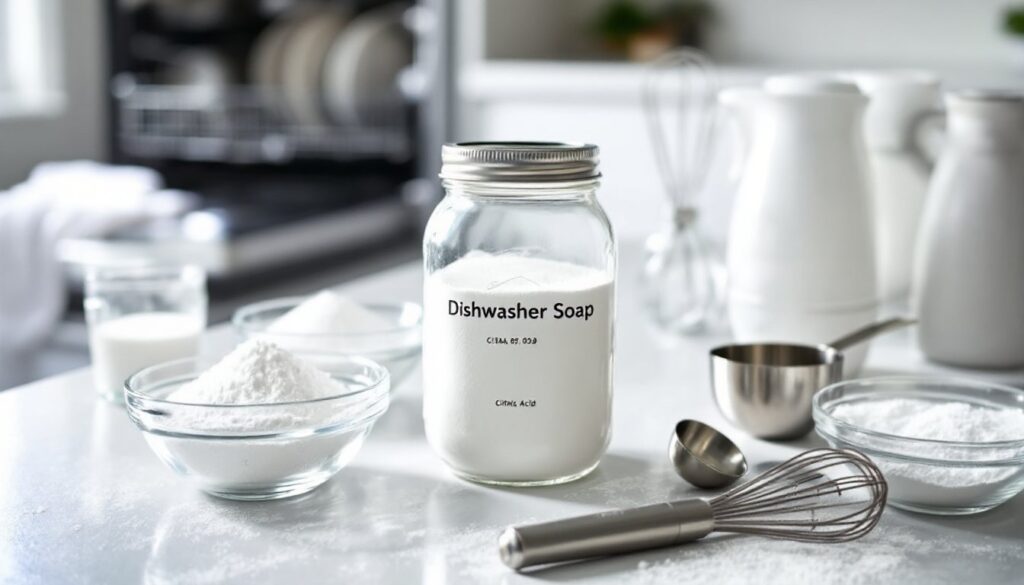
Store the finished powder in an airtight glass jar away from moisture. A mason jar with a tight-fitting lid keeps it dry and extends shelf life to 6–12 months. Label it clearly with the contents and date.
Liquid Dishwasher Soap: An Alternative Approach
If you prefer liquid detergent, or if your dishwasher’s dispenser is too narrow for powder, you can make an effective liquid version. This requires an extra step but produces results comparable to the powder formula.
Simple liquid recipe:
• 1 tablespoon washing soda
• 1 tablespoon borax
• ½ teaspoon citric acid
• 2 cups hot water
• Optional: 5–10 drops essential oil (lemon or grapefruit, for scent)
Dissolved in water, this mixture becomes a thin, pourable liquid. Combine all ingredients in a clean quart-sized jar, shake vigorously until dissolved, and let it sit for 24 hours before use. Use 1–2 tablespoons per load, depending on soil level and water hardness.
Liquid detergent doesn’t store as long as powder, about 3–4 months in a cool, dark cabinet. Because it’s water-based, it can separate or grow mold if stored improperly. Shake it before each use and watch for cloudiness or off-smells, which signal spoilage.
Liquid works well for light to moderate loads and for dishwashers with a pre-rinse cycle. For heavily soiled pans or if your water is very hard, the powder formula often performs better.
Essential Ingredients and Where to Find Them
The three core ingredients are available at most grocery stores, health food shops, or online retailers. Understanding what each one does, and where to source it reliably, prevents mistakes and saves money.
Washing Soda (Sodium Carbonate): This is the alkaline workhorse. It’s distinct from baking soda (sodium bicarbonate), which is weaker and won’t produce the same results. Washing soda is often shelved in the laundry section near borax: brands like Arm & Hammer and Bob’s Red Mill are common. A 1-pound box costs $3–$5 and lasts for multiple batches. Home improvement and cleaning guides often recommend washing soda for various household projects because it’s effective and inexpensive.
Borax: A natural mineral compound and powerful cleaner, borax appears in most grocery stores in the laundry aisle. Standard containers hold 1–2 pounds and cost $4–$6. Some regions restrict borax due to local regulations, so verify availability in your area before planning a batch.
Citric Acid: This powdered acid is usually found in the canning section or with specialty baking ingredients. If your local store doesn’t stock it, online retailers carry it cheaply, often under $10 per pound. A little goes a long way, so one container lasts through dozens of batches.
Cost Breakdown (per batch):
• Washing soda: ~$0.30
• Borax: ~$0.25
• Citric acid: ~$0.25
• Total: ~$0.80 per 24-load batch ($0.03 per load)
Compare that to store-bought pods at $0.30–$0.50 per load, and the savings compound quickly.
Step-by-Step Instructions for Best Results
Mixing the Powder Formula:
-
Measure all ingredients. Use a dry measuring cup and level off each ingredient with a flat knife. Any shortcuts in measurement lead to inconsistent results.
-
Combine in a bowl. Pour the 1 cup of washing soda, 1 cup of borax, and ½ cup of citric acid into a large mixing bowl.
-
Whisk thoroughly. Use a wire whisk to break up clumps and ensure even distribution. Spend 2–3 minutes whisking: this step prevents settling during storage.
-
Transfer to storage. Pour the finished powder into a clean, dry glass jar with a tight-fitting lid. Avoid plastic containers, which can absorb residual moisture.
-
Label and date. Write the contents and date mixed on a piece of tape or label so you remember when it was made.
Dosing for Your Dishwasher:
Add 1 tablespoon of powder to your dishwasher’s detergent dispenser cup for a standard load. For heavily soiled dishes (caked-on food, grease), use 1.5 tablespoons or run an extra rinse cycle.
If your machine has a pre-rinse cycle, use it before the main wash: the detergent works more effectively when it hits clean surfaces without food particles.
Key Prep Work:
Rinse large food debris from dishes before loading. Homemade soap is effective at cutting grease and mineral buildup, but it’s not designed to handle large chunks of stuck-on food, that’s what the spray rinse is for. This prep step matters as much as the formula itself.
Tips for Testing and Troubleshooting
Starting Out:
Make a small test batch first. Mix just ¼ cup of each ingredient (scaling the citric acid to ⅛ cup) to confirm the formula works in your specific dishwasher and with your local water. This avoids wasting a full batch if adjustments are needed.
Run a load on your normal cycle and check results. Glasses should be spot-free, plates clean, and silverware without film. If you see white residue or spots, your water is likely hard: add an extra ½ teaspoon of citric acid per batch to compensate.
Common Issues and Fixes:
| Issue | Likely Cause | Solution |
|---|---|---|
| White spots or film on dishes | Hard water buildup | Increase citric acid to ¾ cup per batch: use a rinse aid |
| Dishes still feel greasy | Detergent underdosed or water too cold | Try 1.5 tablespoons per load: check dishwasher’s water heater temperature |
| Powder clumpy or won’t dissolve | Moisture exposure during storage | Store in airtight glass jar away from humidity: whisk before each use |
| Musty or off smell (powder) | Age or contamination | Discard batch: ensure measuring spoons and jars are completely dry |
Hard Water Solutions:
If spot-free results are your priority and you live in a hard water area, consider using homemade dishwasher detergent recipes designed specifically for mineral-heavy water, these usually call for more citric acid or recommend a separate rinse aid. Cascade or Finish rinse aids are commercial options that work well with homemade powder.
Performance Notes:
Homemade formulas excel on routine and moderately soiled loads. For heavily baked-on residue, consider pre-soaking or hand-scrubbing before loading, or use a commercial pod occasionally. There’s no shame in hybrid approaches, many DIYers use homemade soap 90% of the time and commercial detergent for the toughest jobs.
Conclusion
Making dishwasher soap at home is a practical, cost-effective project that takes minimal time and produces results equal to most commercial brands. Start with the simple 3-ingredient powder recipe, test it in your dishwasher, and adjust based on your water hardness and load soil level. Once you dial in the formula that works for your home, you’ll cut costs dramatically while knowing exactly what’s cleaning your dishes. It’s one of those rare DIY projects with immediate, measurable savings, and a genuine sense of control over your home’s chemistry.